Hand to Mouth
(The dummy tells the truth)

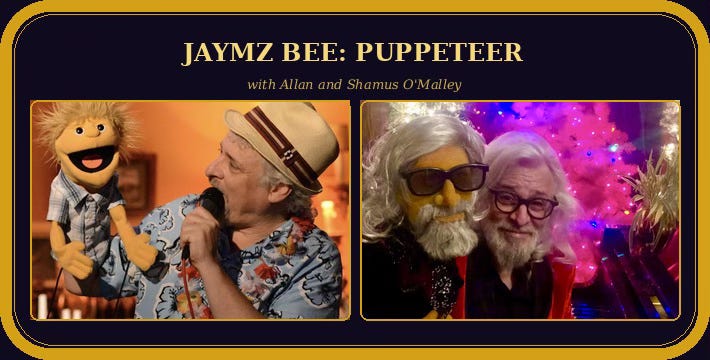
There is a school of thought, advanced by people who should know better, that the puppet is the lower art form. Below the magician. Below the mime. Somewhere in the cultural basement between the guy who makes balloon animals and the actual balloon animals. I grew up knowing this and not caring even slightly, because I had watched Jerome the Giraffe deliver a dry one-liner on The Friendly Giant with more comic timing than most human beings manage in a lifetime, and I understood something fundamental: the hand inside the glove is not the point. The point is what happens to your face when you forget the hand is there.
Let me tell you about Finnegan.
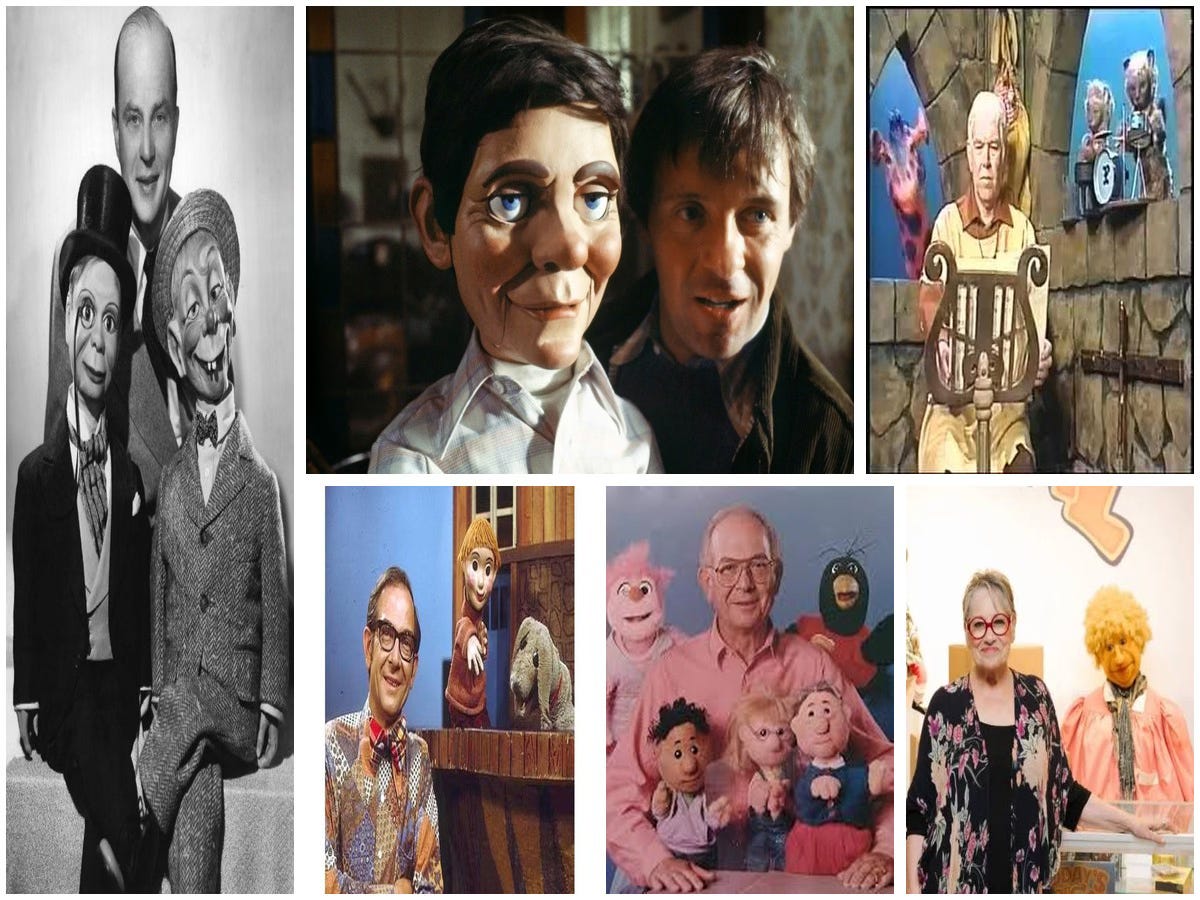
Finnegan was a dog on Mr. Dressup, the great Ernie Coombs presiding, and Finnegan had a mouth that moved but produced no sound. Casey, the other puppet, could speak but had a fixed expression. As a toddler in North Bay, Ontario, I found this arrangement genuinely surreal. Not troubling, exactly. Surreal. Which is, if you think about it, exactly the correct response to puppetry. The ventriloquist’s art is built on a fundamental lie told so beautifully you accept it as a higher truth. The mouth that moves without speaking is just honesty about the whole arrangement. Many of us move our mouths without saying anything worth hearing anyway.
The Friendly Giant was closer to Dalí than to anything designed for children. A tiny castle, furniture, and a roster of small jazz-playing puppets including Jerome the Giraffe, whose comic affect was so dry it could absorb moisture from a room, and Rusty, who had a voice like a hinge that had never met oil. Together they played jazz. A giraffe and a rooster in a castle, playing jazz for children at a civilized hour. Nobody questioned this. This is what television was capable of before it forgot its obligations.
I also have, in the amber of early memory, the image of Edgar Bergen working Charlie McCarthy in some black-and-white film. Bergen was the great paradox of American entertainment: the most celebrated ventriloquist in the country, beloved on radio. On radio. A medium in which his primary skill was, technically, irrelevant. And yet this tells you everything about what ventriloquism actually is. It is not about the lip control. It is about the relationship. Charlie McCarthy had opinions about dames. Mortimer Snerd had opinions about very little. Bergen gave them each a distinct inner life, and America tuned in to hear what the wooden men were thinking. The dummy is not a prop. The dummy is a collaborator. The dummy is, in many respects, the one telling the truth.
Who’s Talking (Playing both sides)
William Goldman wrote a novel called “Magic” in 1976, which became a film with Anthony Hopkins playing a ventriloquist whose dummy, Fats, gradually assumes control of the act and then the man. I read the book and saw the film at an impressionable age and found it only slightly worrying, which tells you either that I had a healthy relationship with my puppets or an unhealthy one depending on your framework. The premise of “Magic” is essentially the premise that every ventriloquist quietly negotiates: at what point does the character stop being something you invented and start being something that invented you? Hopkins plays it as horror. I played it as a business model. Cool Cat never threatened me, exactly. But there were moments, performing, when I was genuinely uncertain who was doing the talking. Goldman understood that the dummy is not the monster in the story. The loss of control is. And any puppeteer who tells you they have never felt the character pulling slightly ahead of them is either lying or not very good.
I entered a talent contest in high school with my first puppet, Cool Cat. Ventriloquism ranked just below magic in the social hierarchy of North Bay talent shows, which gives you a fairly accurate picture of the cultural geography of Northern Ontario circa 1975. But I was undeterred, because I had by then taken a puppet-making course and discovered that you could construct a hand puppet from carpet underlay foam and ping-pong balls and bring something genuinely alive into the world.
I called the company Smirk Incorporated. I hired my friends at twenty-five dollars a show, which was serious money for a 70’s teen, and they showed up reliably, because whatever its social positioning, it was genuinely fun.
The bookings were fire halls, libraries, churches. I charged up to four hundred dollars for a half-hour holiday show. My mother observed, with a mixture of pride and mild alarm, that I was out-earning my parents. She suggested this should be reflected in my gift-giving strategy if I expected Santa to remain engaged.
The star of Smirk Incorporated was Zibby DiMilo, a character from outer space with a voice that could etch glass. Zibby was a bit of a hero in North Bay. A foam-and-ping-pong creation with an abrasive extraterrestrial voice became beloved in a small Canadian city, and the lesson here is not about puppetry specifically but about the appetite people have for something that admits it is pretending. The puppet is honest about its artifice in a way that most entertainment is not. You can see the hand. You choose to believe anyway. This is more sophisticated than what passes for realism.
Before I left North Bay for good, I produced one adult puppet show at Caruso’s Cabaret. It was 1979, the material was sharp, and we decided, with the confidence that only the very young can muster, to smoke pot before the show. The puppets held up better than the humans. One cast member, the only person on that stage without a hand inside him, turned to the adult audience and asked, with genuine philosophical urgency, “who believes in hallucinations?” The silence that followed was the kind that has texture. The show ran one night. I left town shortly after, which was either a coincidence or a lesson about the relationship between cannabis and puppet comedy, namely that the puppets can afford to be out of their minds because they were never in them to begin with.
When I moved to Toronto in 1980, I wrote a show called The History of Sex, which required me to solve a technical problem that had not previously concerned the puppet-making tradition. Specifically: sex changes. The answer was Velcro. A puppet built with Velcro-attached anatomical suggestions could be reconfigured mid-performance, which is either brilliant stagecraft or a profound statement about gender as performance, or both, or neither, depending on the theoretical framework you bring to a strip bar on a Tuesday night. Because this is where I found work: strip bars, performing short shows to a playback cassette for audiences whose primary interest was definitively not puppetry. And yet. And yet they watched.
During this period I auditioned for Fraggle Rock. Jim Henson’s operation represented the pinnacle of what the puppet could be: a fully inhabited world in which the distinction between performer and character had been dissolved completely. Frank Oz, whose hand was Fozzie Bear and Miss Piggy (and later Yoda), had achieved something that the philosophers of the marionette had theorized about in the abstract. The puppet as genuine character. The character as genuinely present. I met Oz. I auditioned. And then my house burned down.
I was inside. I got out. The puppets did not.
Foam, Ping-Pong and Fire. There is a particular grief for the loss of puppets that is not quite like other grief. A puppet is not alive, and everyone knows this, and yet a puppet that you have built and performed with has something in it that belongs to the performances, to the audiences, to the specific moments of belief you and a room of people achieved together. When the house burned, that was gone. I went back to North Bay with no clothes, no house, no puppets, and spent time in a hospital thinking about other things.
I did not do puppetry for decades.
Then one year at the One of a Kind craft show at the CNE grounds, I found Allan. There was a wall of puppets and one of them communicated something to me in the way that a good puppet always does, across the distance of non-sentience. “Take me home”, it said, or I understood it to say. “It is time”. I spell his name with two L’s - Allan and I performed at my private salons and at Loula Lounge or The Old Mill for jazz concerts. During the holiday season Allan sang comic Jewish songs, and I received complaints from people who said I was not Jewish and had no business satirizing the faith, especially at Christmas. My defence had two parts. First, nearly everyone assumed I was Jewish, so the premise of the complaint was shakier than it appeared. Second, who was to say that Allan the puppet wasn’t Jewish? The puppet gets to be what the puppet needs to be. This is not a loophole. This is the entire philosophy. Charlie McCarthy was not Edgar Bergen. Kermit the Frog is not Jim Henson. The character achieves an autonomy that the performer enables but does not own. Allan’s faith was Allan’s business
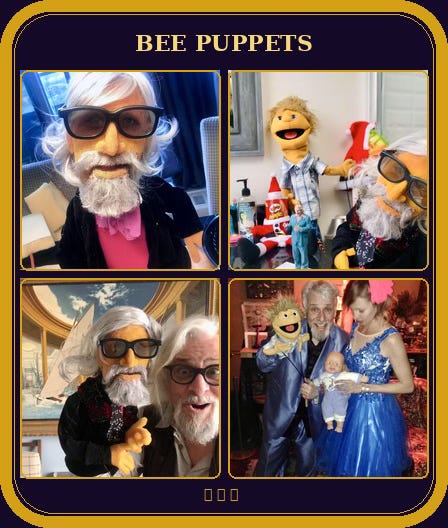
Shamus shots and lower right: Allan blowing it for me on a date. Again!
I later commissioned Nina Keogh, a genuinely accomplished puppeteer and sweet friend, who had worked with Ernie Coombs on Mr. DressUp in the later years (post Casey and Finnegan), to build a puppet that looked like me. I was, at this period in my life, what you might call a freelance narcissist. I had a Jaymz Bee action figure, bobblehead, trophy, and shirts. The puppet was named Shamus O’Malley, officially a Jaymz Bee impersonator, which raises interesting questions about where imitation ends and identity begins - that I am not prepared to answer. Shamus (I insisted is spelling his name incorrectly) made cameos in some of my short films.
I think often about Ronny Birkin, who works in Toronto and is, without qualification, a genius. To watch someone at the absolute top of this form is to be reminded: there is a grace available to the puppet that human beings can approach but never fully reach, because we always know ourselves to be performing, and the knowledge interrupts the grace. The puppet doesn’t know. The puppet just is.
I rarely play the would-have-could-have game. Regret is an inefficient use of a good nervous system. But sometimes the question assembles itself anyway, the way questions do in the hours when the mind is not otherwise occupied. What if the house had not burned? What if the puppets had survived? What if the phone had rung with word from the Fraggle Rock people?
But maybe that’s the point. The fire took the puppets, the call never came, and here I am anyway, doing something else with these hands. The Muppet I would have been is still out there somewhere, in the smoke, in the maybe, in the hours when the mind wanders. Some doors don’t close. They just burn down, and you build something new in the clearing.
Thanks for reading - please share - Subscription is free!
I will leave you with an interview and song from Allan 5 minutes in, after listings), and, I’m sorry…
Thsnkyou for the article and the shout out JB❤️
you are so fackin' brilliant!!!!!!